
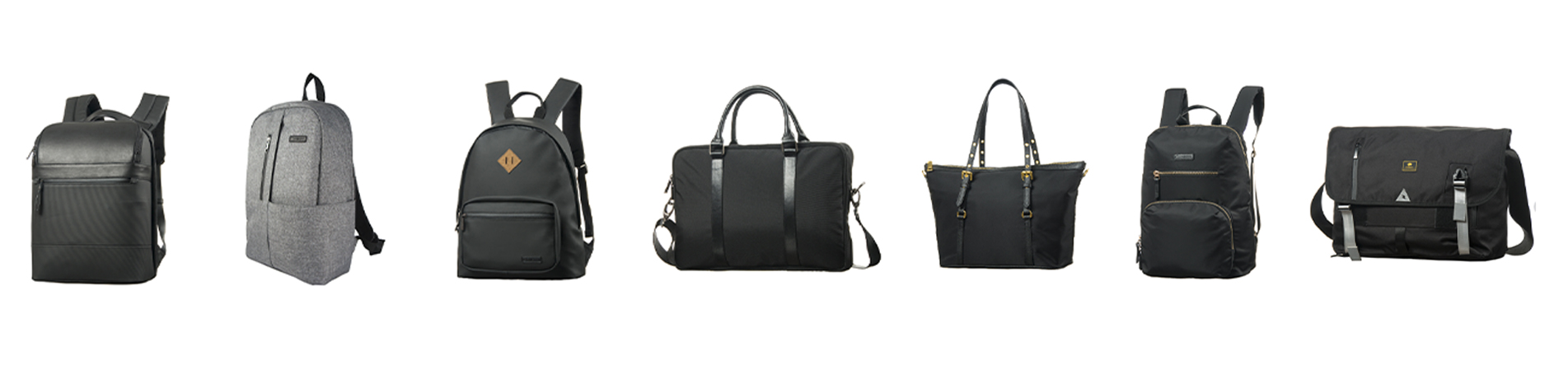
There is no single, unified Amazon US certification standard for ordinary adult backpacks. Compliance requirements generally need to be assessed across multiple dimensions, including the product's intended age group, raw material composition, additional features, compliance regulations applicable in the primary US states where the product will be sold, and Amazon's individualized review requirements for specific ASINs. The corresponding compliance documents and testing obligations should then be determined accordingly.

Table of Contents
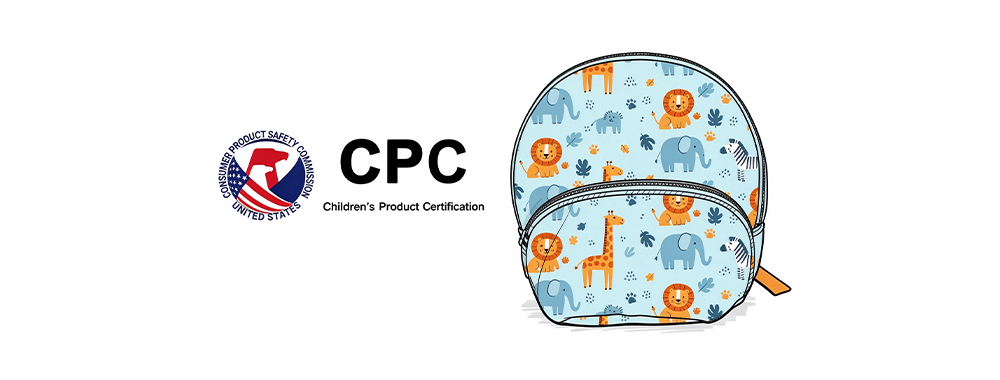
The US Consumer Product Safety Commission (CPSC) has a clear, legally binding definition of a "children's product": a consumer product specifically designed for children aged 12 or younger, or primarily intended for use by children aged 12 or younger. This classification is not determined by the seller's subjective marketing claims.
Children's backpacks and school backpacks unquestionably fall within this regulatory scope.
Amazon's review requirements for children's backpacks are very specific. Products must comply with CPSIA Section 101 (lead content), Washington State Children's Safe Products Act (CSPA), RCW 70.240.020 (phthalates and cadmium), 16 CFR 1500.50, and applicable small parts warning requirements.
In practice, many brands specializing in customized backpacks actually launch adult-oriented or general-purpose products. However, due to the use of imprecise keywords in their Amazon listings, product photography with a childlike aesthetic, or even misclassification by Amazon's automated categorization algorithms, their products may be classified by the system as "children's backpacks" or "children's school supplies." This can subsequently trigger compliance corrective action notices from Amazon.
When appealing such decisions, sellers need to provide sufficient evidence demonstrating that their products are not designed or intended for use by children.
Therefore, the first practical recommendation is as follows: If your branded backpacks are genuinely not designed for children, ensure that the listing copy, main and secondary product images, and lifestyle scenarios displayed on the A+ Content page clearly communicate the product's adult-oriented positioning. Explicitly showcase adult use cases such as commuting, travel, and outdoor activities.
Even so, Amazon may still request compliance documentation, particularly when the product features cartoon patterns, highly saturated and bright colors, or appears in search results associated with terms related to "school supplies."
Once a product is classified as a children's product, a CPC (Children's Product Certificate) becomes an unavoidable mandatory compliance requirement.
It is important to clarify that a CPC is not a "qualification certificate" issued by a government agency. Rather, it is a compliance declaration independently prepared by the manufacturer or importer, who assumes full legal responsibility for its accuracy and validity.
However, the issuance of a CPC must be supported by a passing test report issued by a third-party laboratory recognized by the CPSC. A CPC without a valid supporting test report does not have legal compliance validity.
However, there is one important point that needs to be clarified first: The original regulatory language specifically applies to "children's toys" and "child care articles." In Amazon's CPC review practices, children's backpacks are generally assessed within this regulatory framework. Therefore, preparing for testing against all eight restricted phthalates is a relatively prudent approach when submitting products for testing, as it can help reduce the cost of repeated supplementary testing.
A GCC (General Certificate of Conformity) is a written declaration of compliance required under the US Consumer Product Safety Act (CPSA). It primarily applies to non-children's products (i.e., "general use products") that are subject to specific CPSC safety rules, standards, or bans.
For ordinary adult backpacks that do not fall under any applicable mandatory regulations, a GCC is generally not automatically required.
The issuance process for a GCC is similar to that of a CPC. It is also a compliance declaration independently issued by the US importer or manufacturer based on a reasonable testing program.
The difference is that a CPC specifically requires supporting test reports issued by a CPSC-accepted third-party laboratory, whereas a GCC only needs to be based on a "reasonable testing program." For customized backpack brands, testing can be conducted either by the company's internal laboratory or through an outsourced third-party laboratory.
In actual Amazon compliance practices, requests for GCC documentation for adult backpacks are far less common and stringent than requests for CPC documentation for children's backpacks.
The more common risk remains the misclassification of a product as a children's product, which subsequently triggers CPC requirements.
Therefore, clearly communicating the product's positioning in the Amazon listing and avoiding factors that could trigger children's product classification should remain a higher priority than proactively obtaining a GCC.
The most commonly referenced requirement is the flammability standard for clothing textiles under 16 CFR Part 1610. Although the name of this standard specifically refers to clothing, the CPSC's practical compliance guidance also extends its scope to certain textile products intended to be worn. If the textile materials used in a backpack are included in the assessment, flammability testing is generally conducted in accordance with this standard.
Starting July 8, 2026, consumer products regulated by the CPSC must have their compliance certificate information electronically filed with US Customs when imported into the United States through the eFiling system.
In simple terms, previously, once a CPC or GCC certificate had been issued, the seller could retain it and present it if requested during a customs inspection. Under the new system, however, certificate information must be proactively submitted electronically through the US Customs and Border Protection's Automated Commercial Environment (ACE) system at the time of importation.
The key point is that eFiling does not change testing requirements and does not require products to undergo retesting. Existing valid test reports remain valid; only the method of submission has changed.
However, if you have not coordinated the electronic filing process with your customs broker in advance, your shipment may face inspection delays or even detention when it arrives at the port.
The information required for filing includes seven data elements, such as the product ID, applicable regulatory codes, manufacturing date and location, testing date, and laboratory information.
For customized backpack brands, this means that an additional coordination step is required within the supply chain and logistics process: Confirm that your US Importer of Record (IOR) or customs broker has the capability to submit declarations through the ACE system, and organize the data from the CPC certificate into the required filing format before shipment.

Picture display of the entire process of CPSC eFiling declaration in the United States
|
Product Classification |
Key Certifications / Documents |
Mandatory? |
|
Children's backpacks (made entirely of textiles / standard accessories, intended for children aged 12 or younger) |
CPC certificate and import eFiling |
Yes |
|
Children's backpacks with toy-like features |
Children's product requirements + ASTM F963 toy safety testing |
Yes |
|
Adult / general-purpose backpacks |
GCC (if applicable) or compliance documents required by the platform |
No |
|
Backpacks with Bluetooth functionality (e.g., built-in Bluetooth speakers / anti-loss tracking modules) |
CPC/GCC (depending on product positioning) + FCC ID certification |
FCC ID is mandatory |
|
Backpacks with batteries / charging functionality (e.g., built-in lithium batteries, USB charging ports) |
Platform compliance documents + UN38.3 transportation test report + MSDS |
Yes (mandatory for transportation) |
In our cross-border compliance consulting work for customized backpacks, one of the most common situations we encounter is that brands only come to us for urgent confirmation of which compliance documents they need after receiving an Amazon Account Health or performance notification.
These notifications typically contain only general requests, such as "Please provide a CPC" or "Please provide a test report." However, they do not specify exactly which testing items are required, who should issue the documents, or how the reports should correspond to specific ASINs to pass Amazon's review.
The time and cost involved in making these compliance decisions and repeatedly going through trial and error are often more significant than the testing fees themselves.
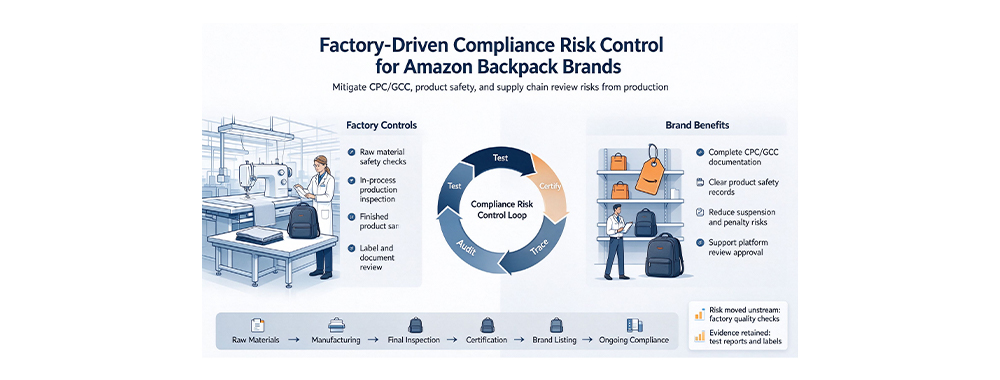
As a professional backpack factory, I generally put the classification logic outlined above into practice before an order officially enters mass production.
Therefore, we recommend that brands provide their target user demographics and a complete list of material compositions before entering the OEM backpack sampling and customization stage. Based on the product positioning, we can help brands identify the specific testing points and applicable standards that need to be communicated to the relevant laboratory.
This helps avoid unnecessary costs caused by excessive testing while also preventing subsequent corrective actions resulting from overlooked mandatory testing items.
In addition, many custom backpacks are not made from a single material. Instead, they consist of multiple components, including outer fabrics, linings, webbing, zippers, plastic buckles, printed coatings, and special decorative components.
During the testing process, several details need to be confirmed with the laboratory in advance:
These are all important details that require advance confirmation.
We help brands break down their product structures and identify all material components that need to be tested, avoiding compliance risks caused by testing only the main fabric while overlooking the lining, webbing, or other components.
Ordinary adult backpacks without electronic functions generally do not require any unified, mandatory "backpack certification." Sellers must still comply with country-of-origin labeling requirements, truthful advertising regulations, applicable state laws, and Amazon's platform review requirements. However, this does not mean that sellers must obtain CPC, CE, or so-called "FDA certification."
Not necessarily. GCC stands for General Certificate of Conformity. It is a written declaration generally translated into Chinese as "General Certificate of Conformity."
It applies to general-use products subject to relevant CPSC safety rules, bans, or standards, rather than being a mandatory document required for all consumer products.
For ordinary backpacks without electronic functions or special protective purposes, primarily intended for everyday adult use, a separate GCC certificate is generally not required if the product does not trigger any mandatory CPSC standards applicable to specific products or risks.
No. ASTM F963 is a dedicated toy safety standard. A product should not automatically be classified as a toy simply because it is intended for use by children.
Only when the backpack itself, its accompanying accessories, or the way the product is marketed and sold gives it clear toy-like characteristics is it necessary to further assess whether toy-related regulations apply.
Generally, yes. Lead limits are a fundamental compliance requirement for children's products.
For backpacks primarily intended for children aged 12 or younger, the total lead content of components accessible to children must be evaluated to determine whether it complies with the limits established under the CPSIA.
It is important to distinguish between lead content testing and phthalate testing, as they are two separate requirements.
Lead content testing focuses on lead as a specific heavy metal and has a broader scope of application. Phthalate testing, on the other hand, applies only to specific plasticized materials in children's toys and child care articles.
Even if a children's backpack does not require phthalate testing, it will generally still need to undergo lead content evaluation.
Amazon.com is a unified US marketplace. Ordinary products generally use the same listing and are sold to consumers throughout the United States. Sellers do not need to create separate "California versions" and "other states versions" of their listings.
We recommend that brands evaluate their products based on nationwide US sales requirements before listing them on Amazon.
When selling backpacks on Amazon US, fiber content labeling is a legal requirement. However, whether a separate care or washing label is mandatory depends on the backpack's material composition and whether it can be washed.
Simply put, as long as a backpack contains textile fibers, such as canvas, nylon, or polyester fabrics, it must have a permanently attached fiber content label sewn into the product.
Care instructions, including washing or cleaning methods, must also be provided. However, for backpacks that cannot be washed, such as leather or PU products, indicating "Wipe Clean" is generally sufficient. It is not necessary to specify washing instructions in every case.
For customized backpacks entering the Amazon US marketplace, the key takeaway is that ordinary adult backpacks do not have a unified certification requirement, while children's backpacks generally require a CPC. The key to compliance is to clearly establish the product's positioning before listing it on Amazon and use that classification as the starting point for determining the appropriate certification pathway.
Therefore, for customized backpack brands, following the full implementation of CPSC eFiling in 2026, the real task is not simply to obtain the required certificates. Instead, brands should work with a professional bag manufacturer and move compliance assessments forward to the product selection and Amazon listing development stages.
First, confirm the intended target users and actual usage scenarios. Then, determine the applicable standards based on the product's material composition, additional features, and target sales regions. Only after these steps should brands prepare the corresponding test reports and compliance documentation.
| Author | ||||||
|
Please Read On, Stay Posted, Subscribe, And We Welcome You To Tell Us What You Think.




Copyright @2024 Synberry Bag & Package Products Co.,Ltd All Rights Reserved.
 Network Supported
Sitemap / Blog / Xml / Privacy Policy