What Is Backpack Back Panel Engineering?
Jul 22, 2026
Backpack back panel engineering refers to a systematic design and development process focused on the structure, materials, and ventilation system of the back panel. Its goal is to achieve the optimal balance among three essential performance factors: support, ergonomic fit, and breathability.
A backpack may feature premium fabrics, smooth zippers, and an attractive appearance—but if the back panel feels hot, stiff, or sticks to the user's back, most consumers are unlikely to use it a second time. In real-world use, the back panel is the first part of the backpack that users truly experience. It determines whether the backpack feels light or heavy, breathable or sweaty, supportive or burdensome. This is why some backpacks earn praise for providing all-day carrying comfort, while others leave users with sore shoulders and back pain after only 20 minutes of use.
Creating an excellent back panel is far from easy. A back panel designed for stronger support often becomes stiffer and less breathable. Prioritizing ventilation, on the other hand, can easily compromise structural support, causing the back panel to deform or collapse during prolonged load-bearing use. Only through repeated refinement of structural configurations, material combinations, and layer construction can manufacturers develop a back panel that delivers a well-balanced carrying experience.
As an OEM/ODM backpack manufacturer with more than 30 years of manufacturing experience, we have always regarded back panel engineering as one of the most critical aspects of backpack development. By continuously refining our solutions around the three core functions—support, breathability, and ergonomic fit—we help brands create backpack products that deliver proven comfort, reliable performance, and consistently positive user feedback.
Table of Contents
What Is a Backpack Back Panel?
The Three Core Technical Dimensions of Back Panel Engineering
Types of Backpack Back Panel Structures
How to Select Foam Materials for Backpack Back Panels
How to Select Contact Layer Materials
How Air Channels Improve Back Panel Performance
Case Study: Typical Back Panel System Architectures
From Design to Mass Production: Quality Control Essentials for Back Panel Systems
Services We Provide for OEM Customers
Frequently Asked Questions (FAQ)
1. What Is a Backpack Back Panel?
A backpack back panel is the structural layer that rests against the user's back, positioned between the wearer and the contents inside the backpack. It determines how the carried load is distributed across the back, how heat is dissipated, and how stable the backpack remains during movement.
If the back panel is poorly designed, users may feel the sharp edges of a laptop or the hard corners of books pressing into their back. Heat and sweat can quickly build up, making the back feel hot and uncomfortable, while the shoulder straps may begin to dig into the shoulders, reducing overall carrying comfort.
2. The Three Core Technical Dimensions of Back Panel Engineering
2.1 Support: From Concentrated Pressure to Even Load Distribution
The human back is not flat. The spine protrudes, the shoulder blades extend outward, and the lower back curves inward. Under load, any rigid object inside the backpack—such as the corner of a laptop, the hard cover of a book, or a power bank—can create concentrated pressure points against the user's back.
The primary engineering task of a backpack back panel is to transform these concentrated pressure points into evenly distributed surface pressure through the elastic deformation of the foam layers. This significantly improves carrying comfort by reducing localized stress on the back.
A key concept involved here is the compression curve of the foam. An ideal back panel foam should remain soft and conform comfortably to the user's back under light loads, gradually become firmer to provide structural support under medium loads, and still retain sufficient thickness under heavy loads without "bottoming out."
Achieving this performance typically requires a multi-layer foam construction rather than simply using a single thick piece of foam. A common engineering approach is to combine a low-density outer foam layer for softness and comfort with a high-density inner foam layer for structural support, allowing the back panel to deliver both cushioning and stability throughout different load conditions.
2.2 Ergonomic Fit: The Secret to a Stable Backpack
The second engineering objective of a backpack back panel is to resist twisting and backward pull. As users walk, turn, or climb stairs, the inertia of the items inside the backpack generates movement and shifting forces. If the back panel is too soft, the backpack tends to sag backward and downward, forcing the shoulder straps to bear additional tension and ultimately causing shoulder fatigue.
A well-engineered back panel must provide sufficient in-plane stiffness. It should remain soft and cushioning in the vertical direction to absorb pressure, while maintaining its shape and resisting deformation in the horizontal direction. This balance helps keep the backpack stable against the user's back, minimizing unwanted movement and improving carrying comfort.
2.3 Breathability: Airflow Is More Than Just Cutting a Few Grooves
The back is one of the body's primary areas for heat dissipation. When a backpack back panel sits completely flush against the user's back, it creates a microclimate at the contact surface—where temperature rises, humidity becomes saturated, and air circulation comes to a halt. The true purpose of an airflow channel design is not simply to make the back panel look more high-tech, but to establish a continuous pathway for air exchange.
However, airflow channels have a counterintuitive characteristic: depth matters more than width. Shallow channels (2–3 mm) are almost completely compressed under load, causing them to lose their ventilation function. In contrast, deeper channels (5–8 mm), combined with structured raised ribs, can remain open even under heavy loads, maintaining effective airflow.
This explains why many backpacks that appear to feature ventilation channels still feel hot and sweaty during actual use—the airflow channels have failed from an engineering standpoint.
So, how can these three technical objectives—support, ergonomic fit, and breathability—be achieved in a single back panel?
In the following sections, we'll break down the core elements of back panel engineering one by one, covering structural designs, material selection, and airflow channel construction, to help you understand the technical details behind building a high-performance backpack back panel.
3. Types of Backpack Back Panel Structures
Based on the three technical dimensions discussed above, backpack back panels on the market can generally be categorized into four structural archetypes:
Structure Type
Core Features
Pressure Management
Heat & Moisture Management
Dynamic Stability
Typical Applications
Flat Padded Back Panel
Single-layer foam with fabric lining
Basic
Poor
Weak
Lightweight backpacks, children's backpacks
Grooved Foam Back Panel
Molded or carved ventilation channels
Good
Moderate
Moderate
Everyday commuting backpacks, school bags
Zoned Support Back Panel
Multi-density foam with zoned support
Excellent
Good
Good
Travel backpacks, laptop backpacks
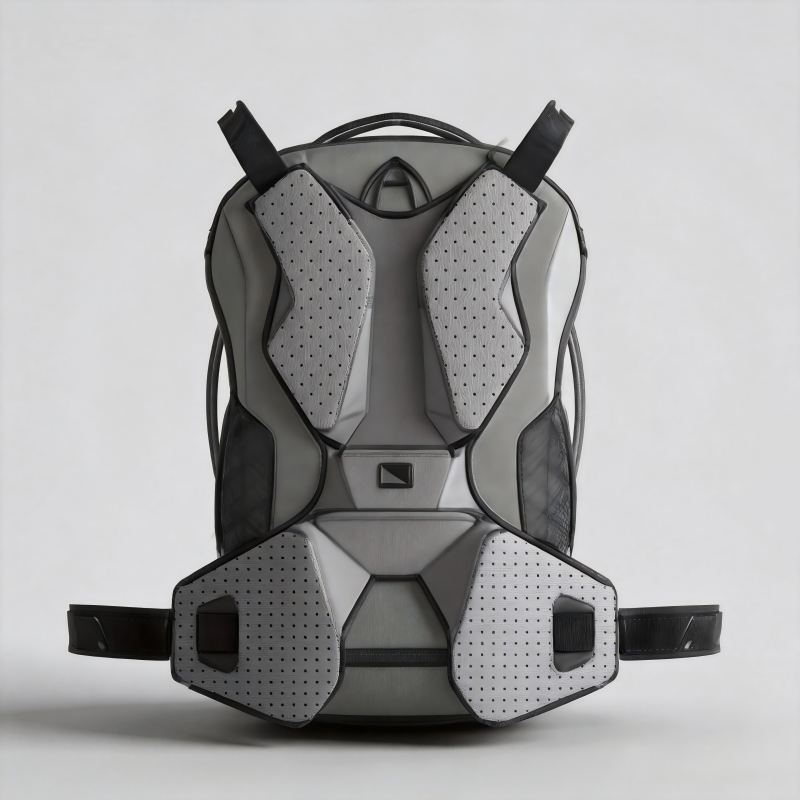
Suspended Frame Back Panel
Tensioned mesh with a rigid frame
Good
Excellent
Excellent
Outdoor backpacks, hiking backpacks
Selection Recommendations: More Expensive Doesn't Always Mean Better—The Right Choice Depends on the Intended Use
Lightweight backpacks and children's backpacks generally carry relatively light loads, so a flat padded back panel is sufficient to meet performance requirements. This design also helps control manufacturing costs while avoiding unnecessary structural components that would add extra weight to the backpack.
Everyday commuting backpacks and school bags require a balanced level of support and breathability. A grooved foam back panel offers the best balance between performance and cost, making it the most cost-effective solution for these applications.
Travel laptop backpacks are often designed to carry one or two laptops along with other daily essentials, resulting in higher overall loads. A zoned support back panel with multi-density foam better conforms to the natural contours of the user's back, distributes pressure more evenly, and improves carrying comfort under heavier loads.
Outdoor hiking backpacks are typically intended for long-distance carrying and often support loads exceeding 10 kg (22 lbs). These backpacks demand the highest levels of breathability and dynamic stability. Only a suspended frame back panel can maintain an open ventilation channel under heavy loads while using a rigid internal frame to transfer weight efficiently to the hips and waist, significantly reducing the burden on the shoulders and back.
4. Selecting Foam Materials for Backpack Back Panels
In back panel engineering, material selection is not about choosing a single material, but about designing a multi-layer system in which different materials work together to achieve the desired performance. The following are the primary materials used in modern back panel systems and their respective engineering roles.
4.1 EVA (Ethylene-Vinyl Acetate)
Function: Structural support layer
Characteristics: Closed-cell structure, water-resistant, thermoformable, excellent shape retention, and fast rebound.
Key Parameters: Density (35–60 kg/m³); Hardness (Asker C 25–65)
Engineering Considerations: When the density falls below 30 kg/m³, the material is more likely to exhibit excessive permanent compression deformation after prolonged use. Conversely, densities above 60 kg/m³ make the foam overly stiff, significantly reducing its cushioning performance.
4.2 PU Foam (Polyurethane Foam)
Function: Comfort cushioning layer
Characteristics: Open-cell structure, soft and resilient, with a premium tactile feel.
Potential Risk: Low-grade PU foam has a high compression set, meaning it is prone to permanent deformation and may noticeably collapse after just 2–3 months of regular use.
Engineering Considerations: PU foam should be combined with an EVA structural support layer to achieve the optimal balance between load-bearing support and long-term carrying comfort.
4.3 Neoprene
Function: Premium comfort layer / shock-absorbing layer
Characteristics: Closed-cell structure, water-resistant, soft, and highly resilient with excellent rebound performance.
Limitations: Naturally retains heat, resulting in poor breathability when used as a flat contact surface.
Engineering Considerations: Neoprene should always be paired with airflow channels and breathable mesh. It is best utilized as a comfort contact layer rather than a structural support layer.
5. Selecting Contact Layer Materials
The foam layers and airflow channel structures solve the problems of support and ventilation. However, the direct interface between the backpack back panel and the user's skin—the contact layer—determines whether sweat can be quickly transported away, whether friction remains comfortable, and whether the material will develop pilling or deformation after long-term use.
Choosing the wrong contact layer can compromise all the engineering efforts invested in the previous stages.
Material Type
Core Characteristics
Recommended Weight / Thickness
Suitable Applications
3D Spacer Mesh (Sandwich Mesh Fabric)
Two layers of mesh fabric connected by vertical monofilament structures, providing moisture transport, sweat management, shock absorption, and breathability
250–700 g/m², thickness: 2–8 mm
The preferred universal choice, covering more than 90% of backpack categories
Bird’s Eye Fabric / Warp-Knitted Mesh
Lightweight, breathable, and cost-effective
120–180 g/m²
Lightweight casual backpacks and bags designed for short-term summer use
Same Fabric as the Backpack Main Body
Creates a consistent visual style and maintains brand identity
Based on the backpack body fabric specifications
Fashion-oriented backpacks and designs that emphasize overall aesthetic integration
Practical Recommendations:
For functional backpacks, prioritize 3D spacer mesh (with a weight of ≥350 g/m²). Mesh materials within this weight range can maintain sufficient three-dimensional space and prevent the back panel from collapsing directly against the user's back under load. This ensures that moisture management and cushioning performance meet the requirements of long-duration daily carrying.
For lightweight casual backpacks, bird’s eye fabric is a suitable choice. It provides sufficient breathability while helping control both manufacturing costs and overall backpack weight.
For fashion-oriented backpacks that emphasize a consistent overall design style, the main body fabric can be directly used as the contact layer. In this case, it is recommended to select fabrics with breathable weaving structures to avoid excessively compromising the user experience.
6. How Air Channels Improve Back Panel Performance
6.1 What Are Ventilation Channels in a Backpack Back Panel?
Ventilation channels are not decorative grooves. They are carefully engineered airflow pathways designed to reduce sweat accumulation, lower skin temperature, and maintain air circulation even when the backpack is carrying a heavy load.
There are two types of airflow mechanisms:
Passive airflow: Generated through walking movements and natural body heat convection.
Pressure-release airflow: When the load changes, compressed air is pushed out through the channels and re-enters the system when pressure is released.
6.2 Basic Airflow Channel Structures
Channel Type
Description
Performance Level
Vertical Grooves
Straight vertical airflow channels
Good
Horizontal Grooves
Lateral airflow pathways
Moderate
Spine Relief Channel
Central gap designed to relieve pressure along the spine
Very Good
Multi-Zone Rib Structure
Raised foam ribs combined with open ventilation grooves
Excellent
For most commercial OEM projects, a spine relief channel combined with side airflow channels can deliver strong performance without creating excessive manufacturing costs.
6.3 The "Critical Point" of Air Channel Depth
Air channels are not simply better when they are deeper. They must exceed a certain critical depth in order to maintain their ventilation function under load. Based on load testing data:
Load Range
Minimum Effective Air Channel Depth
Recommended Air Channel Depth
3–5 kg
3 mm
4–5 mm
5–8 kg
4 mm
5–6 mm
8–12 kg
5 mm
6–8 mm
12 kg+
6 mm
8–12 mm
7. Case Study: Layered Architecture of a Backpack Back Panel System
An engineered backpack back panel is not "a single piece of material," but rather a multi-layer system where different components work together. Below is a typical layered structure for a travel backpack:
Layer 1 (Skin Contact Layer):
3D spacer mesh, 5 mm thickness, 450 g/m²
↓ Function:
Moisture transport, reduced skin friction, and maintaining open airflow channels.
Layer 2 (Comfort Layer):
3 mm PU foam, density: 30 kg/m³
↓ Function:
Provides a soft tactile feel and distributes localized pressure.
Layer 3 (Airflow Structure Layer):
8 mm EVA, density: 45 kg/m³, with molded raised ribs and ventilation channels
↓ Function:
Creates airflow pathways and provides the primary structural support.
Layer 4 (Back Panel Base Layer):
Lining fabric or composite material
↓ Function:
Protects the foam layers and provides a stable connection with the main backpack body fabric through sewing construction.
Manufacturing Experience Sharing:
Multi-layer stacking is not simply a matter of bonding different materials together in sequence. The lamination process between each layer directly affects the final carrying experience.
For back panels featuring multi-density zoned support, the positioning and alignment of different-density foam components must be carefully controlled in advance. This helps prevent shifting and deformation after molding, ensuring that each support zone accurately corresponds to different pressure distribution areas of the human back.
8. From Design to Mass Production: Quality Control Essentials for Back Panel Systems
8.1 Pre-Production Sample Approval Stage
Foam Density Testing:
Measure whether the foam hardness and thickness are within ±5% of the specified target values to ensure consistency with the design requirements.
Air Channel Depth Measurement:
Test the air channel depth under unloaded conditions to verify molding consistency. Then conduct load testing to measure the effective working depth under pressure, ensuring that the channels maintain the required minimum effective depth according to performance standards.
Overall Carrying Test:
During the sample approval stage, backpacks should be tested by users with different body shapes while carrying realistic loads. The purpose is to simulate daily usage scenarios and identify potential issues such as localized hard pressure points, concentrated discomfort, or insufficient overall fit.
If any comfort or performance issues are discovered, adjustments should be made promptly to the foam density distribution or structural design. Only after the approved sample fully meets the design requirements should the product proceed to mass production.
8.2 Mass Production Stage
During mass production, all parameters confirmed during the pre-production sample approval stage must be strictly implemented, with batch inspections carried out to ensure consistent quality.
First is incoming material inspection.
For each batch of incoming foam materials, hardness and thickness must be verified to ensure consistency. This prevents quality variations in mass production caused by differences between material batches. The contact layer materials should also be randomly sampled for weight and thickness inspection to confirm that they meet the required specifications.
Second is in-process molding inspection.
Manufacturers are required to conduct full-process inspections throughout production to ensure that every manufacturing step complies with the established process requirements.
Finally is finished product final inspection and sampling.
According to the AQL 1.5/4.0 standard, samples are randomly selected from completed sewn backpacks for appearance and functional inspection, including:
Overall flatness of the back panel
Consistency of airflow channel depth
Bonding strength between different layers, including whether there are any issues such as delamination, adhesive failure, or layer shifting
In addition, load-bearing tests should be conducted on selected samples to confirm that the back panel does not experience significant collapse, loss of support performance, or other structural failures under long-term loading conditions. This helps prevent defective products from entering the market.
8.3 Recommended Parameter Checklist for OEM Orders
Parameter Category
Specific Items
Foam Specifications
Material type, thickness, density, hardness, color
Air Channel Specifications
Layout pattern, depth, width, raised rib spacing, molding method
Mesh Specifications
Thickness, weight (GSM), fiber composition, color, whether anti-pilling treatment is applied
Lamination Process
Bonding method, adhesive type
9. Services We Provide for OEM Customers
SYNBERRY specializes in the systematic research and development of backpack back panel engineering. Leveraging more than 30 years of technical experience accumulated in backpack manufacturing, we provide comprehensive technical support throughout the development process for brand customers with different positioning and application scenarios.
Low MOQ development (normally starting from 300–500 pieces, depending on the complexity of the backpack design)
Free structural design consultation
Customized foam density selection
Air channel mold development
Fast sampling (typically 7–15 days)
Comparison samples with different comfort levels
Mass production consistency control
If you have any customized backpack back panel requirements, please feel free to contact us at any time to discuss your specific project details.
FAQ
Q1: Does thicker back panel foam always provide higher comfort?
A: Not necessarily. Overly thick foam can increase the backpack's weight and bulk, and if the foam density is not properly matched, thicker foam may actually be more prone to collapsing. The key lies in the coordinated design of foam thickness, density, and airflow channels.
Q2: Why does the sample feel comfortable when worn, but the mass-produced backpacks feel too stiff?
A: The most common causes are variations in foam hardness or inconsistencies in the lamination process. It is important to ensure that foam hardness remains within the specified tolerance range and to conduct compression testing during the pre-production sample approval stage
Q3: Are neoprene back panels suitable for summer use?
A: Pure flat neoprene back panels are not ideal for summer use because neoprene naturally retains heat. However, when combined with an EVA support layer, breathable airflow channels, and 3D mesh, neoprene back panels can still provide a comfortable carrying experience during summer conditions.
Q4: How deep do airflow channels need to be to work effectively?
A: For daily commuting backpacks (5–8 kg load), a depth of 5–6 mm is recommended. For travel backpacks (8–12 kg load), 6–8 mm is recommended. For outdoor backpacks (12 kg+ load), 8–12 mm is recommended.
The key requirement is that after load testing, the remaining effective airflow channel depth should not be less than 70% of the original depth.
Q5: How should the GSM of 3D mesh be selected?
A:
School backpacks: 250–350 g/m²
Travel backpacks: 350–500 g/m²
Outdoor/sports backpacks: 500–700 g/m²
A mesh material with insufficient weight may stretch and deform over time, causing the airflow channels to lose effectiveness during long-term use.
Q6: How much does back panel design affect the overall backpack cost?
A: It does affect cost. However, by optimizing airflow channel depth and structural design rather than simply increasing material thickness, manufacturers can achieve significant improvements in carrying comfort while maintaining reasonable cost control.
Author






 Network Supported